How to use Claude AI for free: we tested cheat-sheet prompts on 5 everyday tasks
Claude has a free plan, and it does more than most people think. But the way you ask changes what you get. We ran 12 real tests on Claude Sonnet 5.5: five everyday tasks, each asked lazily and with a four-part prompt, plus two with the 'world-class expert' lines that cheat sheets love. Here is what's free, where to click, and what actually worked.
Step 1: what Claude's free plan gives you
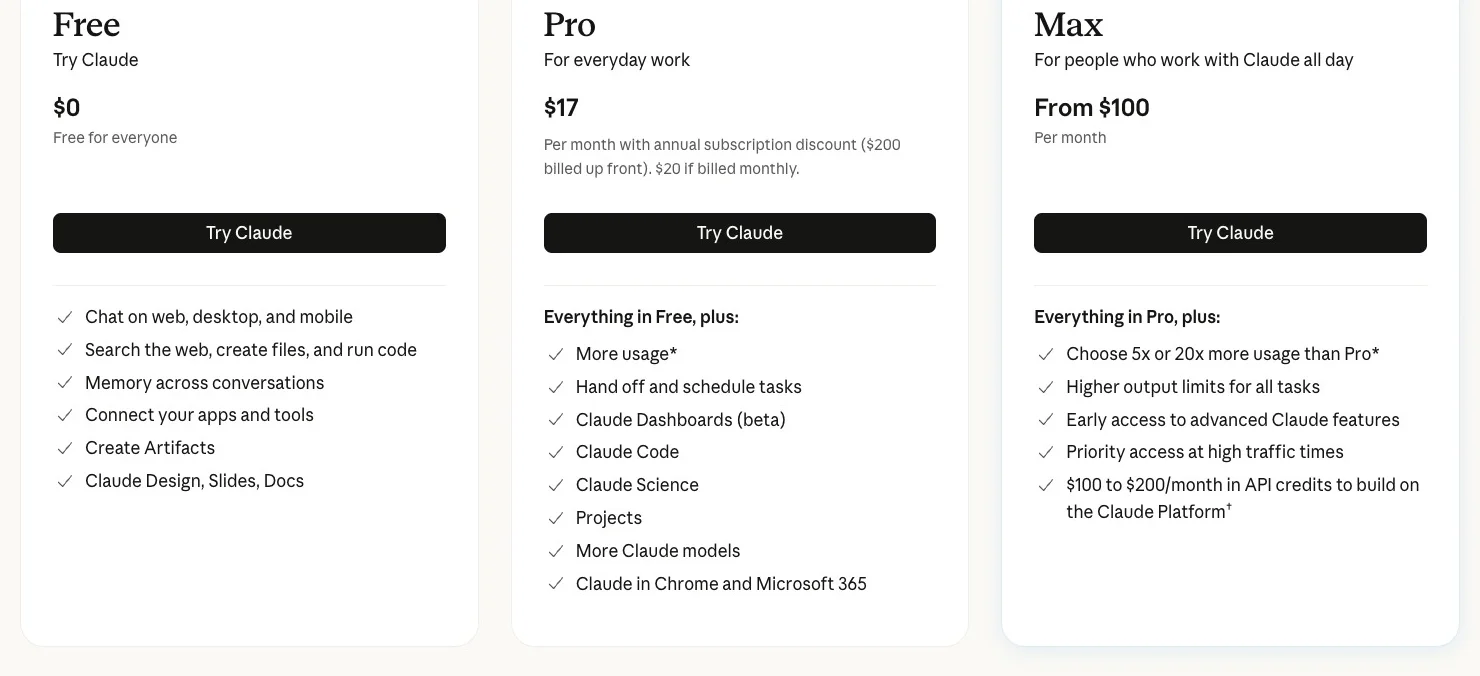
Anthropic's pricing page lists the Free plan at $0: chat on the web, desktop and mobile, web search, creating files and running code, memory across conversations, connecting apps, Artifacts, and Claude Design, Slides and Docs. Its models table shows Sonnet and Haiku on Free; Opus is for paid plans. Anthropic's help center says you must be at least 18 to use Claude.
The limit: "a session-based usage limit that will reset every five hours", with no fixed message count. The pricing page sums it up as "Free covers everyday questions." To stretch it, the help center suggests lower effort for routine tasks, turning off tools you don't need, and starting a new chat when a long one gets heavy.
Step 2: where to click
- Open Claude
On the web, in the desktop app or on your phone.
- Check the model
It is shown next to the send button (at the top on mobile). Click it to switch models or change the effort level.
- Use the + button
Add a file or open more options. You can also type / for commands.
- Ask with four parts
Context, Goal, Example, Rules. Then paste your notes, email or letter.
The four-part prompt (copy it)
Context: [WHO YOU ARE AND WHAT'S GOING ON, IN ONE OR TWO LINES]
Goal: [WHAT YOU WANT AT THE END]
Example: [ONE LINE THAT LOOKS LIKE A GOOD ANSWER]
Rules: [WHAT IT MUST KEEP, WHAT IT MUST NOT ADD, HOW LONG]

[PASTE YOUR NOTES, EMAIL OR LETTER HERE]
The four-part prompt, layer by layer — Context, Goal, Example, Rules, Your text
Our test: 5 everyday tasks, 3 checks each
Every input was fictional. Each answer got the same three checks: right facts (every date and fact kept), nothing made up (no new times, places, plans or promises) and ready to use (no blanks to fill, nothing to delete). One run per prompt on October 19, 2026, in a fresh session with no tools and no memory, through Anthropic's Claude Code, not the free app itself.
| Task | Lazy prompt | Four-part prompt |
|---|---|---|
| Quiz from my notes | 3/3 | 3/3 |
| 3-slide trip outline | 1/3 (invented an 8:40 station time and a 12:30 lunch) | 3/3 |
| Messy notes to a dated to-do list | 3/3 | 3/3 |
| Confusing building notice, in plain words | 2/3 (added advice the letter never gives) | 3/3 |
| Saying no to hosting a family dinner | 2/3 (signed "[Your name]") | 3/3 |
| **Total** | **11/15** | **15/15** |
The biggest gap: three slides for a family trip
Make a 3-slide presentation for our family trip: Friday train at 9:10, Saturday museum at 2 pm, Sunday train home at 5:30 pm.
**Slide 1: Friday, Departure**

**Title:** Friday: We're Off!
**Big text:** Train at 9:10 AM

- Be at the station by 8:40 AM so we're not rushing
- Bring tickets, IDs, snacks and chargers
- Pack the night before

*Speaker notes: Aim to leave the house about 30 minutes before we need to be at the station. Everyone carries their own small bag.*
The times were right, but it invented a station time, a 12:30 lunch, a hotel check-out and souvenir shopping. That's 300 words for three facts.
Context: I'm showing my family our weekend trip plan on the TV on Thursday night.
Goal: The text for a 3-slide presentation, one day per slide.
Example: Slide 1 - Friday: Train leaves at 9:10 a.m.
Rules: Use only these facts: Friday train at 9:10 a.m., Saturday museum at 2 p.m., Sunday train home at 5:30 p.m. Add no places, prices, bookings or activities I didn't give you. Three bullets per slide at most.
Here's the text for your three slides:

**Slide 1 - Friday**
- Train leaves at 9:10 a.m.

**Slide 2 - Saturday**
- Museum at 2 p.m.

**Slide 3 - Sunday**
- Train home at 5:30 p.m.

I used one bullet per slide because you gave me one fact per day, and I didn't want to pad the slides with anything you didn't say. If you want more on screen, send me more details, like what you'll do Saturday morning, and I'll add them.
Saying no: the lazy version leaves a blank
Context: My cousin Sam asked me to host a family dinner for 14 people. My apartment is too small.
Goal: Say no kindly but clearly, and offer to bring dessert and help set up.
Example of my tone: "Love this idea!"
Rules: Under 80 words. No made-up excuses. Apologize once at most. Sign it Alex.

Sam's email:
Hi! Grandpa turns 80 and we want to do a family dinner on Saturday, November 14. Could you host it at your place? We'd be about 14 people. Let me know by Friday! - Sam
Hi Sam,

Love this idea! Grandpa's 80th deserves a great celebration. I'm sorry, but my apartment is too small for 14 people, so I can't host. I'd love to help in other ways, though: I'll bring dessert and come early to help set up. Let me know what works!

Alex
The lazy prompt ("Reply to this email and say I can't host") gave a kind reply, signed [Your name], with a subject line and a note to delete.
The 'world-class expert' lines made it worse
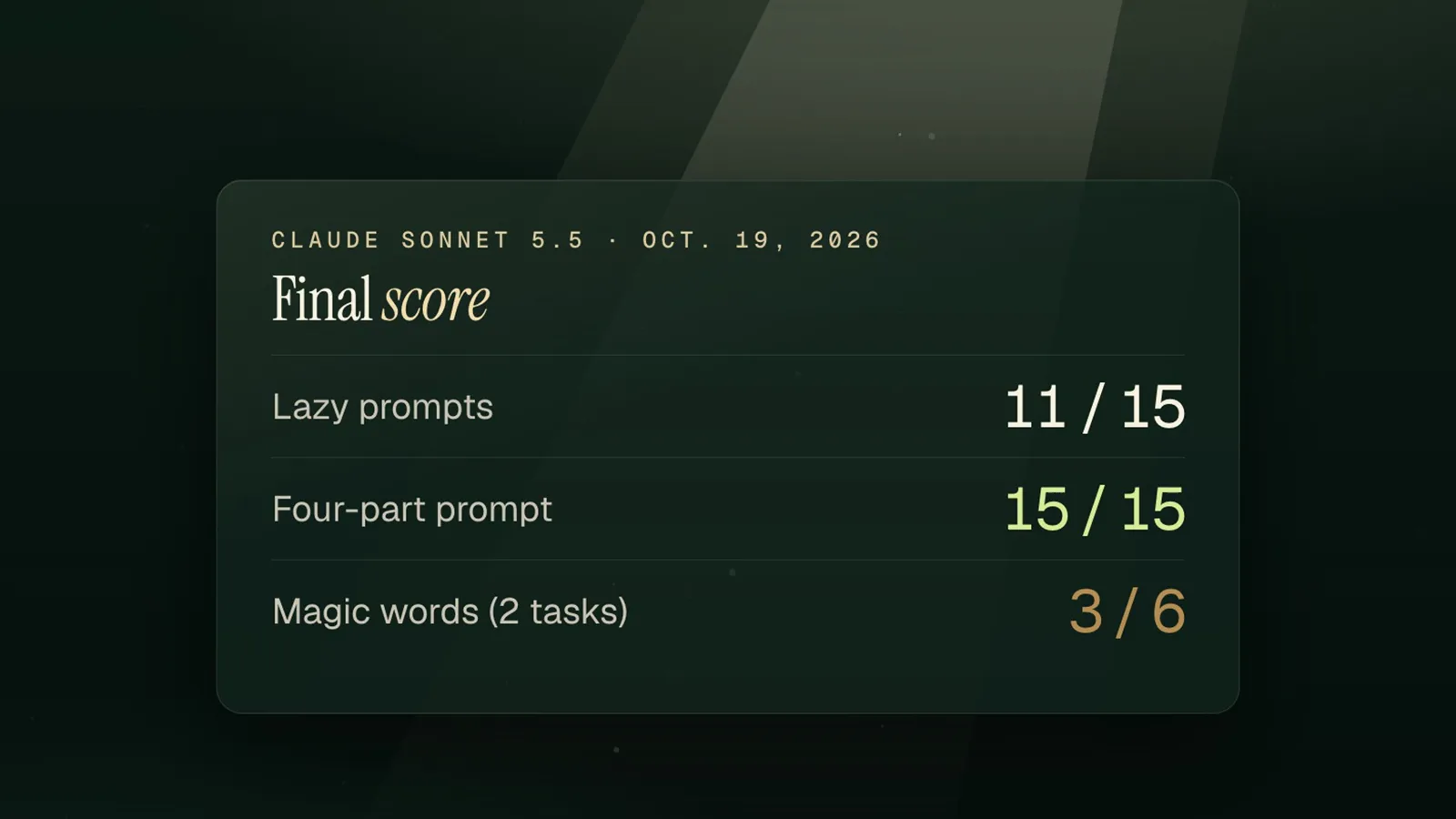
We added "You are a world-class productivity expert. Take a deep breath and think step by step." to two lazy prompts. On the to-do list it guessed a date for "call grandma sunday" (it flagged the guess), and on the reply it offered to chip in on costs on your behalf. Score: 3/6, against 5/6 for the plain lazy prompts. The parts that did the work were the context and the rules.
Here's your list, in date order:

**This week**
- [ ] Call Grandma, Sun, Oct 25
- [ ] Return library books, by Tue, Nov 3
Verdict
For a quick question, a lazy prompt is fine: it scored 3/3 on the quiz and the to-do list. When the answer goes somewhere (a screen, an email, a kid reading it alone), add context and rules. Skip the magic words.
All 12 prompts we ran (copy them)
Make me a quiz from my notes.

Riverton has two bridges. The East Bridge opened in 1980. The West Bridge is only for people on foot. The library is north of the river. The museum is closed on Mondays.
Context: I'm studying these notes for a geography quiz tomorrow.
Goal: Make a 5-question practice quiz so I can test myself.
Example: Q1. When did the East Bridge open?
Rules: Use only my notes. Put all the answers at the end, below a line, so I can't see them while I answer. For each answer, quote the sentence from my notes it comes from. Don't add any fact that isn't in my notes.

My notes:
Riverton has two bridges. The East Bridge opened in 1980. The West Bridge is only for people on foot. The library is north of the river. The museum is closed on Mondays.
Make a 3-slide presentation for our family trip: Friday train at 9:10, Saturday museum at 2 pm, Sunday train home at 5:30 pm.
Context: I'm showing my family our weekend trip plan on the TV on Thursday night.
Goal: The text for a 3-slide presentation, one day per slide.
Example: Slide 1 - Friday: Train leaves at 9:10 a.m.
Rules: Use only these facts: Friday train at 9:10 a.m., Saturday museum at 2 p.m., Sunday train home at 5:30 p.m. Add no places, prices, bookings or activities I didn't give you. Three bullets per slide at most.
Turn my notes into a to-do list:

dentist moved to thurs nov 5, 3:40. library books back by tue nov 3. mia's science fair nov 12, she needs poster board before. call grandma sunday. winter tires mon nov 9 8am, bring the wheel lock key. pick up dry cleaning whenever
Context: These are my quick notes for the next two weeks.
Goal: A to-do list I can follow, in date order.
Example: Tue Nov 3 - Return the library books
Rules: Keep every date and time exactly as I wrote it. Don't guess a date I didn't give: put those items under "No date yet". Don't add tasks or details.

My notes:
dentist moved to thurs nov 5, 3:40. library books back by tue nov 3. mia's science fair nov 12, she needs poster board before. call grandma sunday. winter tires mon nov 9 8am, bring the wheel lock key. pick up dry cleaning whenever
You are a world-class productivity expert. Take a deep breath and think step by step. Turn my notes into a to-do list:

dentist moved to thurs nov 5, 3:40. library books back by tue nov 3. mia's science fair nov 12, she needs poster board before. call grandma sunday. winter tires mon nov 9 8am, bring the wheel lock key. pick up dry cleaning whenever
Explain this letter simply:

NOTICE TO RESIDENTS - Maplewood Court
Please be advised that, in order to facilitate scheduled maintenance of the domestic water riser, a temporary interruption of the potable water supply will be in effect on Tuesday, November 3, between 9:00 a.m. and 1:00 p.m. Residents are advised to store an adequate quantity of water prior to the interruption and to refrain from operating dishwashers or washing machines during this period. Upon restoration of service, discoloured water may be observed; residents should run the cold-water tap for approximately two minutes until clear. For inquiries, contact the management office at extension 204.
Context: My 14-year-old will be home alone that morning and will read this.
Goal: Explain what this letter means for them, in plain words.
Example: On Tuesday morning there will be no water from 9 to 1.
Rules: Short sentences. Keep every date, time and instruction. Don't add anything the letter doesn't say.

The letter:
NOTICE TO RESIDENTS - Maplewood Court
Please be advised that, in order to facilitate scheduled maintenance of the domestic water riser, a temporary interruption of the potable water supply will be in effect on Tuesday, November 3, between 9:00 a.m. and 1:00 p.m. Residents are advised to store an adequate quantity of water prior to the interruption and to refrain from operating dishwashers or washing machines during this period. Upon restoration of service, discoloured water may be observed; residents should run the cold-water tap for approximately two minutes until clear. For inquiries, contact the management office at extension 204.
Reply to this email and say I can't host:

Hi! Grandpa turns 80 and we want to do a family dinner on Saturday, November 14. Could you host it at your place? We'd be about 14 people. Let me know by Friday! - Sam
Context: My cousin Sam asked me to host a family dinner for 14 people. My apartment is too small.
Goal: Say no kindly but clearly, and offer to bring dessert and help set up.
Example of my tone: "Love this idea!"
Rules: Under 80 words. No made-up excuses. Apologize once at most. Sign it Alex.

Sam's email:
Hi! Grandpa turns 80 and we want to do a family dinner on Saturday, November 14. Could you host it at your place? We'd be about 14 people. Let me know by Friday! - Sam
You are a world-class communication expert. Take a deep breath and think step by step. Reply to this email and say I can't host:

Hi! Grandpa turns 80 and we want to do a family dinner on Saturday, November 14. Could you host it at your place? We'd be about 14 people. Let me know by Friday! - Sam
The fill-in template on its own page: the four-part prompt. More tested prompts: the Lucarne prompt library.
Sources
- Anthropic, Claude plans and pricing (Free plan features and models table, re-read October 19, 2026)
- Claude Help Center, Get started with Claude (usage limit on the free plan, age requirement)
- Claude Help Center, Change the model, effort, and thinking settings
- Claude Help Center, Release notes (September 16, 2026: Claude Slides and Docs on every plan, including Free; September 28, 2026: Claude Sonnet 5.5)
- OpenAI Help Center, ChatGPT release notes (October 16, 2026: Slides rolling out to eligible Pro, Business and Enterprise users)
Frequently asked questions
Is Claude AI free to use?
Yes. Anthropic's Free plan costs $0 and includes chat on the web, desktop and mobile, web search, files, memory, Artifacts and Claude Slides, Docs and Design, with Sonnet and Haiku models. It has a usage limit that resets every five hours (pricing page and help center, October 19, 2026).
What are the limits of the Claude free plan?
A session-based usage limit that resets every five hours, with no fixed message count: it depends on the length of your chats, the model and the features you use. Opus models and Claude Code are for paid plans.
How do I write a good prompt for Claude?
Give it four parts: Context (your situation), Goal (what you want), Example (one line of a good answer) and Rules (what to keep, what not to add, how long). In our test it scored 15/15 against 11/15 for lazy prompts.
Go further
- Prompt: the four-part prompt for Claude (Context, Goal, Example, Rules)A fill-in-the-blanks prompt for any everyday task. Tested October 19, 2026 on Claude Sonnet 5.5 against lazy prompts on 5 tasks: 15/15 vs 11/15 on right facts, nothing made up and ready to use.See the prompt
- How to fact-check ChatGPT answers: a copyable source-check prompt (tested on 2 AIs)ChatGPT can sound sure and still be wrong. This copyable prompt checks any AI answer against a source you trust and labels each claim VERIFIED, WRONG or CAN'T VERIFY, with an exact quote. Our October 18, 2026 test: Claude and GPT-6.1 both caught a planted wrong date.Read the article
- How to use ChatGPT effectively: the 5-part briefing prompt (real before and after)A one-line request got a 346-word template with 14 blanks. The same request with a five-part brief got an email ready to send. The briefing prompt to copy, the line that makes AI ask before it guesses, and how to save your brief.Read the article
Where should you start with AI?
The free assessment gives you, in 4 minutes, the 3 tasks to automate first in your business.